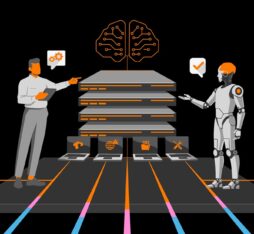


● Strategically, the integration of agentic AI is shifting from human “in the loop” (direct assistance) to human “on the loop” (supervision), with the ultimate goal of systems that can operate “out of the loop” and make fluid decisions.
● Research innovations, such as MIT’s MBTL algorithm, are optimizing agent reliability by making agent training up to 50 times more efficient.
By 2027, agent specialization will drive 70% of MASs to have agents with restricted and targeted roles. This will improve accuracy but make coordination more complex, especially because MASs carry a risk of cumulative errors. According to analyst firm Gartner, implementing strong governance for AI agents is a priority for companies. This must be done through clear supervision, established ethics, and compliance rules. Testing and observing these systems is therefore a priority. Steve Jarrett, Chief Data and AI Officer at Orange, emphasized at Orange OpenTech: “You need very good tools that allow you to manage and control AI agents on a large scale, regardless of the AI models you choose.” AI agents’ performance depends on their autonomy, which nevertheless requires safeguards. “We should compare AI agents to young developers who are prone to making mistakes but are still very talented.” For the specialist, agents are relevant for tasks that require creating a draft first and then having someone analyze the quality of that draft.
The model can take the time to think about how it wishes to accomplish a task: it has autonomy in the choice of tools
According to Deloitte, which published a report on “Unlocking exponential value with AI agent orchestration” in November 2025, the autonomy of agents can only be achieved gradually. For now, the dominant systems are MASs in which agents provide recommendations and analyses, while humans make decisions or carry out actions. The company believes that we should quickly move from the “human-in-the-loop” model to the “human-on-the-loop” model, where MASs will gain greater decision-making freedom and where humans will be primarily in a supervisory role.
Governance and Security: Managing Digital “Talents” That Are Still Fallible
For Steve Jarrett, the agents enable a breakthrough because “the model can take the time to think about how it wishes to accomplish a task: It has autonomy in the choice of tools.” Indeed, the latest model identified by Deloitte, “humans out of the loop,” assumes that MASs will be fully autonomous, able to make decisions in a fluid and continuous way, with humans intervening to refine their parameters or manage exceptional cases. However, the study specifies: “The lack of digital workforce operational standards may make building, configuring and deploying AI agents decentralized and uncoordinated. This, in turn, will likely increase potential risks and costs of performance degradation and ethical, cyber and regulatory compliance issues.”
Optimization and Reliability: The Strategic Benefit of the MBTL Algorithm
The risk of hallucinations, inherent in LLMs, is multiplied when we give AI agents more autonomy, Jarrett warns: “They can make mistakes and also cause excessive consumption of energy or money. We need to determine at what point a human should be in the loop and identify when it is appropriate to observe the agents. This is what we call co-intelligence.” This will require better management of shared memory between agents to prevent them from contradicting each other when executing complex tasks.
Some training methods make agents more reliable and efficient. MIT is developing the MBTL (Model-Based Transfer Learning) algorithm, the role of which is to train reinforcement learning models in a more strategic manner. Instead of training AI on each task individually or on all tasks at once, the algorithm selects a small subset of critical tasks that maximize overall performance. The method is 5 to 50 times more efficient than standard approaches, MIT notes: “For instance, with a 50x efficiency boost, the MBTL algorithm could train on just two tasks and achieve the same performance as a standard method which uses data from 100 tasks.”
 Steve Jarrett