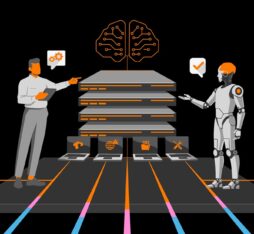
• Still in the experimental phase, generative AI and agent-based AI point to a new era in network automation.
• Network automation will simplify management, reduce associated costs, and optimize performance and energy consumption.
A long-standing promise, the convergence of IT and telecoms is now a reality. Network Functions Virtualization (NFV) has made it possible to decouple network services from the hardware infrastructure by deploying them as software. Objective: to break free from dependencies on specific hardware layers. A more recent trend, the “cloudification” of telecom infrastructures adds an additional layer of abstraction, paving the way for a horizontal model in which network functions run on a shared platform that promotes greater openness. However, new services and innovations have transformed telecom networks into distributed systems that are extremely complex to manage. Teams responsible for their administration and maintenance must analyze a growing number of events, ranging from alarm data reported by equipment to performance metrics and application logs.
While traditional monitoring tools are reaching their limits, artificial intelligence offers the ability to correlate heterogeneous data that is often redundant and lacks context. Objective: to quickly isolate the root cause of an incident (RCA, Root Cause Analytics). In the context of predictive maintenance, this involves continuously monitoring a network’s health to identify potential failures before they impact service quality. “Based on operational history, the algorithms are capable of detecting any abnormal deviation of a key performance indicator (KPI) from its expected behavior,” explains Ilhem Fajjari, a researcher at the Orange Innovation Center in Châtillon. “Subsequently, corrective action may involve self-healing mechanisms, such as restarting or reconfiguring certain network functions. The goal is to resolve the issue as quickly as possible before it affects the user experience. Even the slightest degradation has a direct impact on the quality of an audio call or video streaming.”
With the concept of self-healing, a smart network is capable of automatically diagnosing and correcting certain failures, anomalies, or degrade in service quality, with little or no human intervention. The performance metrics tracked are related to the infrastructure itself (CPU, RAM, disk space), network functions, or the user experience, such as session setup time or user throughput.
How far should we go in network autonomy? “At this stage, full autonomy remains premature,” says Ilhem Fajjari, a researcher at Orange, pointing to the risks of misinterpretation and lack of transparency.
Reducing energy consumption
Beyond maintenance, other major use cases involve network configuration—applying the best settings—and optimization. “By anticipating the load on network cells and servers, it is possible to optimize the operation of a mobile network,” explains Zwi Altman, a research engineer at the same Orange site. “Turning off certain cells during periods of low traffic will, for example, reduce the network’s energy consumption and thus its environmental impact.”
The design of dedicated machine learning algorithms relies on the MLOps (Machine Learning Operations). Drawing on DevOps principles, this set of practices aims to industrialize a model’s lifecycle across the various stages of training, validation, deployment, and monitoring. MLOps is also part of a continuous improvement framework. “Retraining is a key lever for adjusting models and maintaining their performance over time,” explains Ilhem Fajjari.
Giving instructions in natural language
The telecom industry could not ignore the wave of generative AI. Using large language models (LLMs), “intent management” involves controlling a network by expressing the expected result in natural language, then letting the system translate that intent into concrete actions. “Proof-of-concept (POC) tests are currently underway,” says Zwi Altman.
As the next evolution of generative AI, agent-based AI takes network automation a step further by deploying an army of specialized intelligent agents that coordinate to trigger a series of actions based on objectives and events.
How far should network automation go? On the scale established by the TM Forum alliance, which includes five maturity levels, Orange is aiming for Level 4, where AI is widespread while maintaining human oversight (“man in the loop”). “At this stage, full autonomy remains premature,” says Ilhem Fajjari, pointing to the risks of hallucination and opacity. “To avoid the ‘black box’ effect, ongoing work focuses on the explainability of models.”
Finally, there is the issue of sovereignty. The most powerful LLMs are, for the most part, developed by U.S. companies. The three hyperscalers—AWS, Microsoft Azure, and Google Cloud—are also attempting to capture this AIOps market by offering all-in-one cloud solutions to telecom operators, combining network function hosting with AI building blocks.
This text has been translated by an artificial intelligence.