Companies, especially in the tech sector, are wondering how to adopt AI and what frameworks should guide its adoption. At Orange, 100,000 employees are using its internal Dinootoo tool. From acculturation to implementation, what are the specific features of this transformation and how can it be carried out?
As with any technical artifact, when we put a tool in place, it changes the work to be done and the way we do that work
Swift Adoption
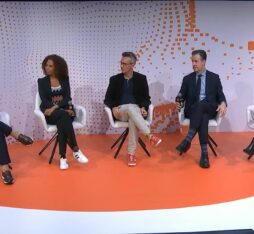
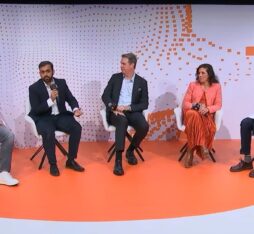
These questions were the core focus of a discussion that took place at the 2025 edition of Orange Open Tech, Orange’s flagship innovation event. They are fundamental, given that AI is profoundly and rapidly reshaping ways of working and collaborating. According to a study by the Institut de l’Entreprise in partnership with McKinsey published in December 2024, 27% of tasks could be automated by 2030! And that’s just one aspect of the multifaceted evolution of business activities being driven by AI tools.
The rapid pace at which this technology is being adopted—with no lag between personal and professional environments—is one of the factors that set it apart from others, says Rémy Oudghiri, Managing Director of Sociovision. “In terms of usage, currently it is most commonly employed for processing information,” he explains. “Two other use cases are emerging and it is clear that they are going to grow. First, there’s the advisory function (…), which means that those not in AI’s sphere of influence or recommendation, in particular companies and brands, risk being left behind. The other is healthcare. If we look at France, where access to healthcare is difficult, AI is a kind of stopgap that people are using more and more.”
Identified Impacts on Work
What impact is AI having on companies and their employees’ professional lives? Marc-Éric Bobillier-Chaumon, Director of the Chair of Work Psychology at CNAM, notes that as with any technical artifact, “when we put a tool in place, it changes the work to be done (…) and the way we do that work.” He says that the impacts beginning to be identified include a “paradox of apparent efficiency: AI will relieve you of repetitive, unstimulating tasks and give you the opportunity to shift to tasks with higher added value, thereby regaining a sense of meaning and interest. But such mundane activities and tasks may actually be important to me, because they give me time to rest at work and recharge for creative and innovative thinking.” A further consequence of delegating low-level activities to AI in this way is the fact that workers may find themselves only carrying out high-level tasks, necessitating much greater engagement. Another possible repercussion is the rise of workplace isolation: Instead of interacting with colleagues, people are now turning to technology to find solutions to problems. Marc-Éric Bobillier-Chaumon puts forward the importance of designing “supportive” AI to avoid this risk, as it would allow employees to remain the protagonists, the authors and the doers of their own work.
Ilhem Alleaume, a scientific advisor at the Haut-commissariat à la stratégie et au plan (French High Commission for Strategy and Planning), also addressed the impact on employment and skills. “This is a source of real concern. Acculturation and training processes will reveal where real added value lies in different sectors (…). In terms of time and productivity gains, the key is understanding how to leverage AI in a professional context, training everyone and identifying where there is real added value in incorporating it into the work of the teams closest to the field.”
The Keys to Trust
How are these impacts approached in practical terms at a company like Orange? Vincent Lecerf, Executive Vice President of Human Resources, shares his vision: Activities without AI are going to be replaced by activities with AI, so we must get employees on board with this transformation. “The idea is to center things around humans and collaborate with them, which requires training and development,” but also to provide an acculturation tool, Dinootoo, as well as a network of ambassadors to support them.
The starting point of the conversation is the notion of trust, and the need to establish a framework where technological intervention is not to the detriment of human intervention. Vincent Lecerf explains the actions Orange is taking in that regard: “Our aim is to provide a framework that earns people’s trust, based on four factors — ethical principles, inclusive AI, responsible AI and sovereign AI. AI presents an opportunity to transform our businesses and support them, and to create new tasks. But we have to do that with people, by including them.”
One key figure comes up at the start and end of the discussion: 60% of the jobs that exist today did not exist in 1940. Work is evolving and being transformed on the back of industrial, technological, digital and other innovations. Given its disruptive nature, AI is undoubtedly one of the most significant of such innovations, and it thus requires enhanced, continuous efforts in terms of support and education — a point emphasized by the speakers.
Dinootoo, the AI tool used by 100,000 users at Orange — three questions for Vincent Lecerf, Executive Vice President of Human Resources at Orange :
What differentiates AI-led transformation within the Orange Group from previous transformation drives?
Vincent Lecerf: Several things, but firstly its speed. Rarely, if ever, will a technology have been adopted so quickly and so eagerly, including outside of Orange. We all see ourselves using AI to learn and search for information. It’s also set apart by its versatility: It allows you to do lots of things, and do them more efficiently. These particular characteristics mean that AI has wide-ranging impacts and is bringing about change at a much greater pace compared to any other tool or innovation.
Despite that remarkable intensity, we are still in a phase of discovery and assimilation with it. AI has not yet profoundly changed “real life” and its impact, in the long run, will be much greater than anything we’ve seen before in terms of uses, practices and activities. That said, our main aim here, as with every new technology, is not so much to replace tasks, but rather to harness the opportunities it presents to create or accomplish more, and do it faster.
Dinootoo is at the heart of the Group’s AI adoption movement; where are we with its rollout?
VL: Dinootoo is one aspect of a more global adoption. It was first necessary to create conditions for trust, which is acquired through knowledge; in other words, through training and use. We have also put safeguards in place to ensure that AI is used in accordance with an ethical, inclusive, sovereign and responsible framework.
In this regard, Dinootoo is a major driver for properly understanding AI and productivity, while maintaining security for the company and its employees. A large number of them are using it: We have surpassed the milestone of 100,000 unique users, while 60,000 employees have been trained to use it and 25,000 have been supported by our network of ambassadors on specific use cases.
Beyond the success of Dinootoo, what actions still need to be launched or ramped up?
VL: The next step must be to focus on use cases and their potentiation. The goal is to move from the sandbox to industrialization, and to identify what will make a difference and add value in everyday use. That is where we have set our trajectory, and we already have some examples of concrete applications. That includes the field of training, where we have rolled out the My Skills solution, which has been turbocharged with AI and is able to recommend training modules or mobility opportunities based on employees’ self-stated skills, helping them target the best career development opportunities for them.