

• These grids are managed via a digital platform and smart meters (Orange Smart Metering), enabling consumption tracking and prepaid electricity payments via Orange Money.
• According to initial feedback, these grids enable rural households to improve their standard of living through new income-generating activities or increased productivity.
Due to low population density, expanding centralized power grids is too costly in many countries, particularly in sub-Saharan Africa, where nearly half the population still lacks access to electricity. Furthermore, a significant portion of the electricity consumed is never paid for, which hinders investment.
Mini-grids enable a shift from survival entrepreneurship to opportunity entrepreneurship
Solar Home Systems (SHS) partially address this need. Combining innovation in products (solar panels and batteries), usage (payment via USSD), and business models (pay-as-you-go), these individual solutions meet basic needs (lighting, mobile charging, small fans, radios, etc.), but cannot support more energy-intensive professional or domestic uses.
A model designed for greater equity and efficiency
Decentralized (“off-grid”) alternatives exist, explains Nat-Sy Missamou, Head of Orange Energies in Africa and the Middle East. “The mini-grid model relies on decentralized production with a shared infrastructure—which minimizes the cost per kWh compared to a solar home system (SHS)—and is suited for villages far from major national grids. Each household is equipped with a smart meter. We have developed a platform, Orange Smart Energies, capable of managing these smart meters, much like a Linky [smart meter in France] adapted to African contexts.” Residents manage their consumption via Orange Money, receive SMS alerts when their credit runs low, and can instantly top up their account. “Electricity is paid for before it is consumed. This provides economic security for the projects while remaining very accessible to residents.”
Since 2025, such hybrid mini-grids (solar, batteries, and diesel) have been providing affordable electricity to Kalinko and Siguirini in Guinea (about 8,000 residents each), rural areas lacking energy infrastructure. The company Solar Grid Guinée deployed the infrastructure (partially subsidized) and maintains it. The World Bank, AFD through the Guinean Rural Electrification Agency (AGER), and private partners (Orange and IPT Powertech, an electricity producer) financed the project. The telecom tower powered by this mini-grid ensures the project’s economic viability. The business model is based on the assumption that stable, affordable electricity will have positive economic and social impacts by stimulating local activity and an expected increase in the well-being of the population. Erwan Le Quentrec, head of a social sciences research team at Orange, explains: “To make the model viable and replicable, we must demonstrate that the economic growth generated by the mini-grid covers its total cost of installation and maintenance (total cost of ownership) over its lifespan.”
Positive initial feedback
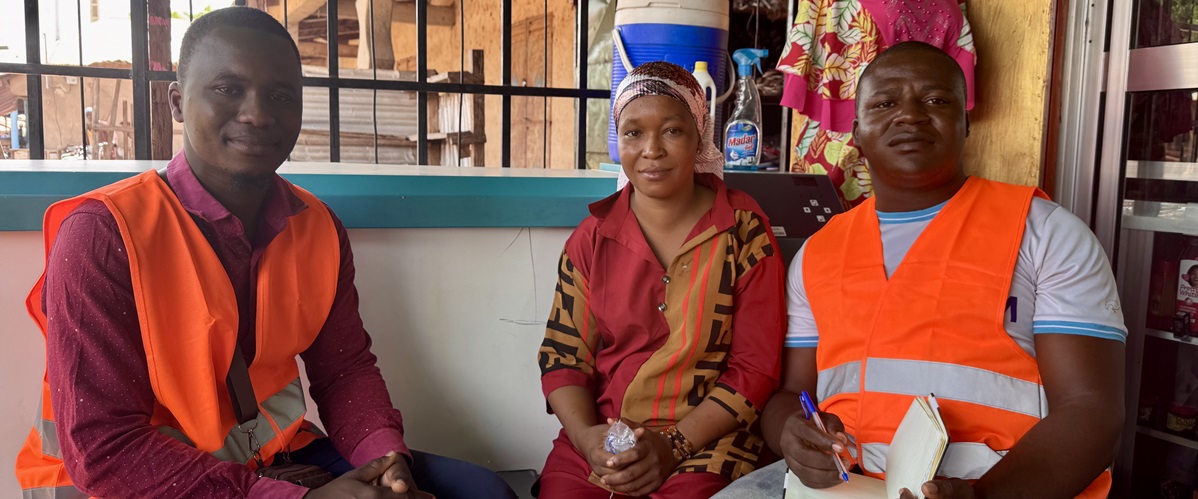
Orange Research has been conducting a quantitative and qualitative impact study in both locations since 2025, explains Virginie Comblon, a development economist at Orange. “More than 900 households have already been surveyed prior to the installation of the mini-grids in the pilot and control villages, and a second round of surveys is planned for this summer to assess changes in economic activity, education, digital usage, and living conditions.”
The qualitative phase (individual interviews and focus groups) conducted in April 2026 highlights real changes and a very high level of satisfaction among beneficiaries. Previously, residents relied either on small, rudimentary installations or on solar home systems (SHS), and for the most energy-intensive activities, on generators—which were expensive, noisy, polluting, and unreliable. “The power would come on for a few hours, then cut out without warning, and tensions were so high that some technicians in charge of these generators received threats,” explains Servane Fauvet, a research engineer at Orange.
Since the mini-grid was installed, commercial and professional uses have multiplied: cafés equipped with espresso machines, electric embroidery machines, sales of cold drinks and Italian ice cream, and the storage of perishable goods in freezers. Some residents are setting up paid Wi-Fi hotspots powered by electricity from the grid. “The mini-grid enables a shift from survival-based entrepreneurship to opportunity-based entrepreneurship,” emphasizes Servane Fauvet. “Residents are coming up with new services, new businesses, and new economic activities.”
Electrification is impacting public services. The local clinic can now store vaccines and light the examination rooms at a lower cost compared to previous solutions. “Electrification also appears to be a lever against rural exodus. A computer engineer trained in Conakry decided to stay and work in Kalinko after the arrival of the power grid because he sees real opportunities there to grow his business,” notes the researcher.
Although access to the grid is relatively affordable, the cost of wiring homes remains a barrier for the poorest households. Schools and other public infrastructure are awaiting funding to be connected.
This model of rural electrification therefore appears to be sustainable, economically viable, and capable of creating local impact. For Servane Fauvet, “here, stable and low-cost electricity offers many new economic and social opportunities.”
 Erwan Le Quentrec
Virginie Comblon
Erwan Le Quentrec
Virginie Comblon