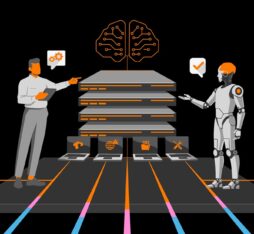
• Across 585 square meters, live demonstrations—digital twins, AI agents, deepfake detection—show how these innovations are being applied in the real world.
• Around sixty startups selected through Orange’s open innovation programs are enriching Orange’s demonstration setup with their own use cases and solutions.
This year, a simple idea lies at the heart of Orange’s presence at VivaTech 2026: technology realizes its full value when it meets concrete needs. What makes large-scale AI, secure communications, service continuity, and more possible is a high-performance, resilient, and secure network. Orange is harnessing the full power of its networks, infrastructure, and expertise to foster a digital ecosystem that is trustworthy, useful, and inclusive. Surrounding the operator, a network of startups has been selected to accelerate innovation where it makes the most sense. It is this triad of “network, useful innovation, and open innovation” that Orange invites visitors to explore at its nearly 600-square-meter booth during the tenth edition of VivaTech.
This annual event is first and foremost a meeting place for companies, startups, investors, and developers. For four days, the global tech ecosystem converges at Porte de Versailles in Paris. Some sixty startups selected through Orange’s open innovation programs—Orange Fab, FrenchTech 2030, and a recent partnership with ZEBOX, the accelerator of CMA CGM—complement Orange’s demonstrations. Each startup extends a concrete use case, adds a complementary building block, or tests a hypothesis at full scale.
Networks: When Infrastructure Becomes Smart
As AI demands ever-increasing bandwidth, controlled latency, and flawless availability, the network has become a strategic asset. Orange invites you to discover this at its booth at VivaTech. With Network Digital Twins, field teams can, for example, check the network status using natural language, simulate an outage before it happens, or prepare a response with more context. The result: fewer unnecessary trips, faster interventions, and better service continuity. Also at the booth, the startup TernWaves, for example, extends this concept to low-bandwidth satellite networks to ensure service in areas with limited coverage or in certain critical situations.
Deepfake detection follows the same logic. Identity theft via synthetic voice or video has become a real operational risk for professionals. Whether it involves contact center fraud, manipulation during video conferences, or fake documents, Orange integrates detection algorithms directly into business tools, as close as possible to high-risk situations.
Several startups at the booth are addressing these security and infrastructure challenges: NeuralTrust enables the testing and monitoring of AI agents throughout their deployment, while Cryptonext Security prepares infrastructures for the arrival of quantum computers, which will render current cryptographic standards obsolete.
Agent-based AI: Moving Beyond Experimental Settings
The Future Ready Business area, meanwhile, addresses a simple question: Does AI deliver on its promises in real-world environments? The Live Intelligence demonstration provides a concrete answer. In the digital twin of a port area, AI agents detect risky situations, anticipate supply chain disruptions, and propose corrective actions. Usage is facilitated by natural language interactions. This solution involves partners such as Ensemble Analytics, which orchestrates the sequence of actions between the various AI agents. The entire system runs on Orange’s own infrastructure. In other words: data never leaves the company’s premises.
Orange Drone 360 addresses another industrial challenge: the various risks posed by drones near critical infrastructure. The solution combines multisensory detection, dynamic mapping, and unified monitoring. Orange Drone 360 is available as a service, without the need for significant hardware investment.
Another example is the startup Forgis, which uses agent-based AI to make complex industrial systems more adaptable in real time (fewer shutdowns, greater responsiveness on production lines). Meanwhile, the startup TomPaero is developing remotely piloted aircraft via the Orange network, with onboard AI assistance to ensure flight safety and assist the pilot in critical situations.
Innovation takes a back seat to practical application
In the Future Ready Experience space, Orange demonstrates how services can be made more accessible, more intuitive, and tailored to real-world challenges. Trusted Interactions leverages Orange’s network APIs to secure registration processes and make calls more transparent through caller identification. Conversion rates, answer rates, and fraud reduction: these are measurable benefits driven by the network itself. As for Tap to Pay, the idea is to transform a smartphone into a certified NFC payment terminal: a mobile solution requiring no hardware investment for merchants, artisans, and micro-entrepreneurs who need it.
At VivaTech, Orange isn’t presenting a catalog of technologies. Here, every demonstration and every participating startup answers the same question: how can innovation be made useful in very concrete contexts? It is this guiding principle that connects a digital twin of a network, a cybersecurity escape game, and a smartphone payment terminal.
Tech That Speaks to Everyone :
On Saturday, June 20, the Future Ready Society space opens its doors to the general public. Protocol 404 is a tablet-based escape game that simulates a cyberattack—phishing, ransomware, and decision-making under pressure—to teach the right reflexes in a practical way. Also featured is “Don’t Go to the Police,” a documentary produced by Orange Cyberdefense that recounts a real-life cyberattack and its ripple effects. Finally, For Good Connections addresses responsible digital use: screen time, cyberbullying, youth usage… Trusted technology, indeed, also depends on educating those who use it.